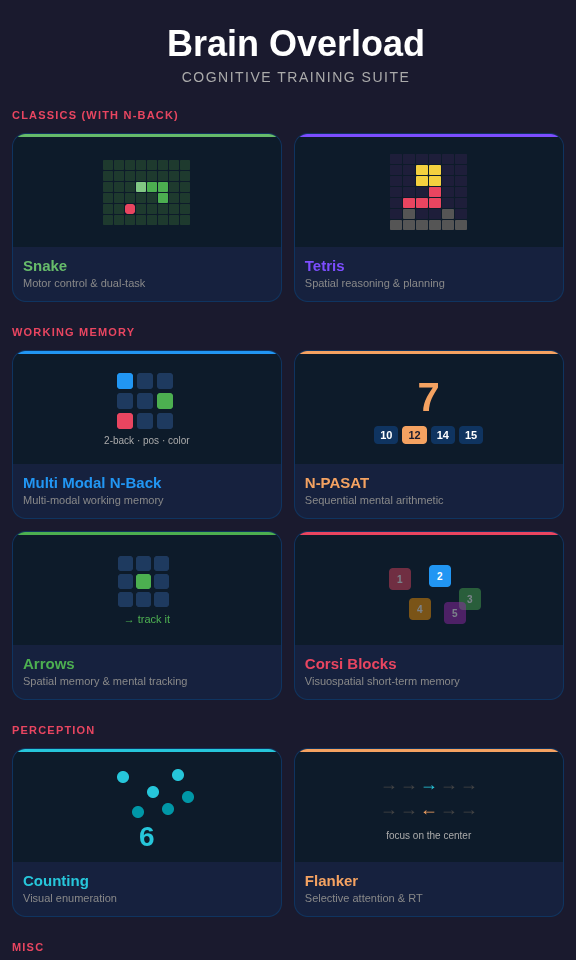
Brain Overload
A cognitive training game that fuses multi-modal N-Back and N-PASAT with classic arcade games — Tetris and Snake — to push working memory and divided attention to their limits.
The Science
Working memory — the ability to hold and manipulate information in mind — is one of the strongest predictors of general fluid intelligence. In a landmark 2008 study published in PNAS, Susanne Jaeggi and Martin Buschkuehl demonstrated that training on the dual N-Back task produced significant, transferable gains in fluid intelligence (Gf), challenging the long-held assumption that Gf is fixed and untrainable.
The N-Back task requires you to monitor a sequence of stimuli (visual positions, spoken letters, or both) and respond whenever the current stimulus matches the one from N steps ago. The dual variant runs two independent streams simultaneously — one visual, one auditory — forcing the brain to maintain, update, and cross-reference two working memory buffers at once. The difficulty parameter N scales dynamically: succeed and the task gets harder; struggle and it eases back.
The N-PASAT (N-Back Paced Auditory Serial Addition Test) is a related paradigm that stacks arithmetic demands on top of the sequential memory load. You must add each new incoming number to the one you heard N items ago — a task that taxes both phonological working memory and executive control simultaneously.
Jaeggi & Buschkuehl's follow-up work showed dose-dependent effects: more training sessions correlated with larger Gf gains, suggesting the brain's executive networks genuinely adapt under sustained, adaptive pressure — not merely that participants learn to game a fixed test format.
The Game
Brain Overload takes this research seriously and makes it genuinely fun. Rather than clinical click-through trials, the N-Back and N-PASAT tasks are embedded inside classic arcade experiences:
- Tetris mode — falling pieces encode the N-Back visual channel. You rotate and place pieces while simultaneously tracking the N-Back sequence. The spatial demands of Tetris compete for the same visuospatial scratchpad that the visual N-Back relies on, deliberately increasing cognitive load.
- Snake mode — navigating the snake occupies motor-planning resources while the auditory N-Back and N-PASAT streams run in parallel. The pacing of the snake's movement is tied to the stimulus interval, so you can never fully decouple the two tasks.
The combined load forces the prefrontal and parietal executive networks to arbitrate between game-state tracking, sequence memory, and arithmetic — the exact circuits Jaeggi & Buschkuehl identified as the substrate of fluid intelligence gains.
Difficulty adapts continuously: the N-Back depth, PASAT pacing, and game speed all adjust based on your accuracy, keeping you in the optimal challenge zone described by Csikszentmihalyi's flow theory.
References
- Jaeggi, S. M., Buschkuehl, M., Jonides, J., & Perrig, W. J. (2008). Improving fluid intelligence with training on working memory. PNAS, 105(19), 6829–6833.
- Buschkuehl, M., & Jaeggi, S. M. (2010). Improving intelligence: A literature review. Swiss Medical Weekly, 140, w13047.
- Conway, A. R. A., Kane, M. J., & Engle, R. W. (2003). Working memory capacity and its relation to general intelligence. Trends in Cognitive Sciences, 7(12), 547–552.